

Weekly Brief
×Be first to read the latest tech news, Industry Leader's Insights, and CIO interviews of medium and large enterprises exclusively from Financial Services Review
Financial Services Review: Specials Magazine
Cross-border commerce is no longer constrained by market access but by how efficiently money moves between systems, jurisdictions, and counterparties. Payment infrastructure has shifted from a back-office function to a critical operational control layer, one that determines how quickly and reliably businesses can execute at scale. Businesses operating across regions now require coordinated oversight of collections, payouts, and liquidity, without the delays introduced by fragmented banking relationships and manual reconciliation. As that complexity grows, financial operations are moving toward system-level orchestration rather than disconnected workflows. This is where Airwallex positions its execution model. Unified Financial Infrastructure Airwallex operates as a financial platform that consolidates payments, multi-currency accounts, payouts, and card issuing into a single API-driven environment. Its infrastructure is built on direct integrations with local payment rails and licensed banking partners, enabling businesses to move funds across geographies while reducing reliance on traditional correspondent banking chains. At the core of the platform are Global Accounts, which allow businesses to hold, receive, and send funds in multiple currencies from a single system. This is paired with embedded payment capabilities that support card payments, local payment methods, and bank transfers across regions, creating a cohesive infrastructure layer rather than a collection of independent tools requiring separate management. Execution is driven by system design rather than manual coordination. Automated reconciliation, structured payment routing, and near real-time FX execution with transparent pricing allow finance teams to operate with greater precision. Financial workflows are integrated directly into business systems rather than managed as separate processes, eliminating the friction that typically accompanies cross-border financial operations.
Accounting and Tax Service
Why do Western compliance assumptions fail in North Asian tax environments? Service On New Grounds (SONG) competes in North Asian markets often dominated by Big Four firms, but differentiates itself through pragmatism and an ‘in-between’ model that bridges regulator and client perspectives. When businesses expand into China, Hong Kong or Japan, regulatory compliance cannot operate on Western assumptions. Tax registration must align with evolving digital systems, VAT positions face increasing automated scrutiny, and documentation is evaluated through locally interpreted enforcement frameworks. Operating for over 20 years, SONG’s pragmatic, step-by-step approach assesses a client’s current compliance position, reviews historical filings, analyzes process gaps, and prepares for enforcement interactions. The sustained, on-the-ground engagement with regional tax authorities provides insight not just into what regulations state, but how they are interpreted and applied in practice. By anticipating enforcement expectations and structuring responses, SONG enables local and foreign clients to navigate compliance without losing operational momentum. “We don’t approach tax solely from a regulator’s lens or purely from a client’s side,” says Yvon Russon, CEO. “Our role is to understand how enforcement works in practice so clients can respond clearly and avoid difficult situations.” SONG is also a member of SFAI, a global accounting network. It is ranked among the top international networks by the International Accounting Bulletin, further strengthening its ability to support clients with cross-border expertise. Building Resilient Tax and Operational Structures How does tax automation change compliance risks for multinational companies? As China’s tax environment has shifted toward automation and system-driven enforcement, SONG helps com.

Wealth Management

For high-net-worth families, wealth isn’t a collection of holdings. It’s a living, breathing system. Portfolios stretch across geographies, asset classes and generations. Investment insight is rarely the issue. The challenge lies in acting on that insight. Executing decisions swiftly and precisely across a web of global custodians, advisors and product providers is where real complexity comes crashing in. And that’s where most traditional systems fall short. Sino Suisse Capital’s precision-driven platform, myAlphaTrader, was built as a direct solution to eliminating those bottlenecks and enhancing clarity at every step. Its distinction is most visible in how market data is processed and executed. Where conventional advisors toggle between emails, spreadsheets and portals to compare investment options, Sino Suisse Capital’s infrastructure is already connected, via secure API integrations, with a network of banks, custodians and platforms. The system captures incoming data automatically, interprets it and ranks product pricing in real time based on regulatory execution standards. There’s no manual scanning or delays. Just the best available decision surfaced instantly. “We built an architecture that thinks in sync with our clients’ intent,” says Franck Chen, president and chief operating officer. “Not after the fact, but in the moment. Because when timing defines trust, speed without strategy is just noise.” That strategic intelligence isn’t detached either. It’s deeply human. Every client engagement begins with nuance, not just assets and allocations but ambitions, concerns and life patterns. Insight becomes the foundation for how the system adapts and responds, ensuring that decisions remain personalized, even as scale and automation step in. For families planning across generations, that system extends even further through intelligent structures like Singapore’s Variable Capital Company (VCC). These frameworks allow for seamless consolidation of global assets, efficient estate transitions and cross-border compliance, without adding new layers of complexity. This translates into a model that doesn’t just manage wealth but anticipates it. It operates as an embedded strategist. Clients aren’t left waiting for updates. They move confidently, knowing their portfolios and goals are being managed with intelligence designed to think ahead.
Accounting and Tax Service
From Financial Guesswork to Structured Leadership Many small and mid-sized businesses appear profitable yet operate without true financial clarity. Revenue grows, but cash remains unpredictable. Owners often make decisions based on their bank balance rather than structured financial data, creating stress and limiting confidence in growth. What appears as success on paper often hides instability beneath the surface. TFO Solutions LLC addresses this challenge by shifting financial management from reactive reporting to forward-looking leadership. “Most profitable companies are financially reckless, and they don’t even know it,” says Tina O’Banion, founder and CEO.
Investment Advisory
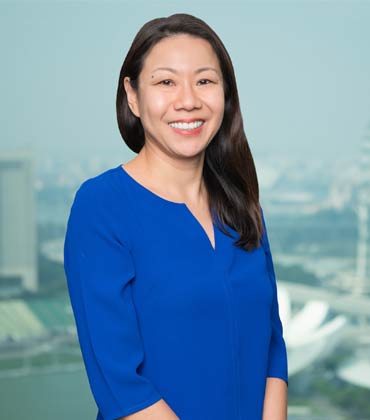
Learning from the Food Industry to Progress Sustainable Investing
Eugenia Koh, MD, Global Head, Sustainable Finance, WRB, Standard Chartered Bank [LON: STAN]
Wealth Management

Navigating the Complexities of Commercial Finance
Tom Wallace, Director of Transformation & Project Management, Volvo Financial Services
Business Loan

The Role of Finance Transformation In Organizational Success
Pablo Montanes, Associate Director & Head of Performance North America, Kraft Heinz
Investment Advisory

Navigating Investment Strategies: Insights For Portfolio Managers
Fitri Lindawati Lubis, Head of Fixed Income, Allianz Indonesia
Financial Risk & Compliance
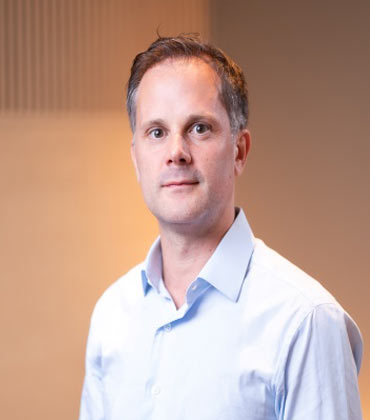
Turning Compliance into a Financial Advantage
Thomas LAGRIFFOUL, Regional Director of Compliance APAC, Coface
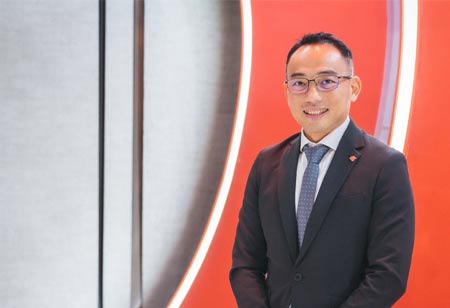
IN MY OPINION
Investment Management
Investment Value Chain in the World of Insurance
Alex Chin, Chief Investment Officer, Generali Malaysia

LAST WORD
Claim Adjusting
The AI-Driven Financial Revolution: From Transaction Recorder to Strategic Value Architect
Elyn Chen, Global CFO, HCP Packaging USA, Inc
IN FOCUS

Modern Accounting: Enhancing APAC Financial Service Efficiency
Tax and accounting services in APAC evolve through automation, digital compliance, advisory expansion, and data-driven insights, improving accuracy, efficiency, and strategic decision-making.
Tax And Accounting In APAC: Driving Strategic Alignment
Tax and accounting services in APAC enable compliance, enhance financial transparency, support strategic planning, and manage complex cross-border regulatory environments effectively.
EDITORIAL
Building Financial Discipline across Borders
As financial systems across the Asia Pacific continue to evolve, regulatory complexity and digital enforcement are reshaping tax governance and financial reporting. In this edition of Financial Services Review APAC, the focus is on the operational discipline and structured advisory frameworks needed to sustain cross-border growth with compliance confidence.
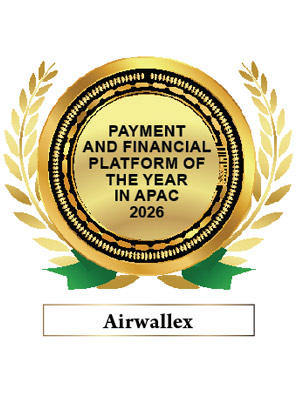
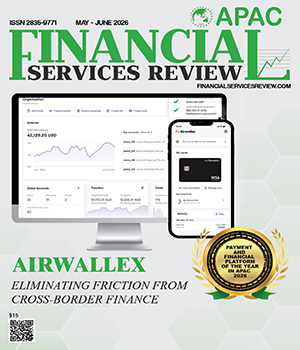
The cover story features Airwallex, honored as Payment and Financial Platform of the Year in APAC 2026, for redefining cross-border financial operations. Its unified infrastructure brings together multi-currency accounts, payments, payouts and expense management in a single API-driven environment, helping businesses move funds efficiently across jurisdictions while reducing dependence on fragmented correspondent banking structures.
Service On New Grounds (SONG), awarded Top Tax and Accounting Service in APAC 2026, is recognized for its pragmatic approach to regulatory alignment across China, Hong Kong and Japan. With more than two decades of regional experience, the firm reviews historical filings, identifies structural gaps and prepares organizations for automated enforcement environments, helping them build resilient tax structures that support operational continuity
Leadership insights further strengthen the discussion around financial resilience. Alex Chin, Chief Investment Officer at Generali Malaysia, underscores the importance of balancing earnings volatility, liquidity and solvency as interconnected drivers of long-term investment stability. He emphasizes that disciplined asset liability alignment and structured portfolio strategies remain central to maintaining profitability and regulatory confidence.
Complementing this perspective, Elyn Chen, Global CFO at HCP Packaging USA, Inc, underscores the transformative power of AI-driven finance and digital strategy. She emphasizes how finance must evolve from a transactional recorder to a strategic value architect, leveraging intelligent automation, unified data platforms, and strong governance frameworks to drive enterprise-wide innovation and sustainable competitive advantage in an increasingly digital economy.
Together, these perspectives demonstrate how practical advisory expertise, disciplined investment strategy and forward-looking financial planning are shaping resilient financial ecosystems across the Asia Pacific. We invite readers to explore this issue and engage with the insights guiding the next phase of compliant and sustainable financial operations.
