


Weekly Brief
×Be first to read the latest tech news, Industry Leader's Insights, and CIO interviews of medium and large enterprises exclusively from Financial Services Review
Financial Services Review: Specials Magazine

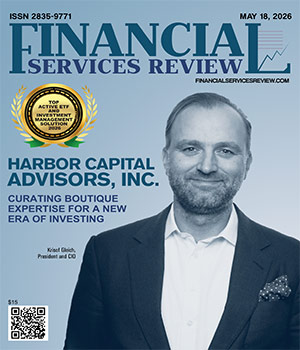
What distinguishes Harbor’s approach to investment management from traditional asset management firms? Art galleries are known for practicing strict curatorial discipline. They scout artists across styles, disciplines and generations, and then curate works that are displayed to the public. The process is deliberate, space is finite, and only a fraction of talented creators make the exhibit. Harbor Capital Advisors, Inc. applies a similar curatorial approach to investment management. Instead of managing all strategies internally, it identifies specialized external managers and partners with them to deliver ETFs, mutual funds and collective investment trusts built around distinct areas of expertise. Its investment managers are the artists, and its suite of ETFs, mutual funds and collective investment trusts represents a curated collection designed to help clients navigate increasingly complex market environments. Traditional asset management firms typically build expansive in-house teams of portfolio managers and roll out products with near assembly-line efficiency. Harbor takes a different route, identifying high-conviction boutique managers with deep domain focus, forming long-term partnerships with them and entrusting them with the day-to-day management of its offerings. Its team evaluates hundreds of potential partners, assessing investment philosophy, portfolio construction discipline, risk management practices and long-term performance consistency before selecting the boutique manager best positioned to execute the investment thesis. “As curators of specialized expertise, our mission is to help investors navigate an increasingly complex world with confidence,” says Krisof Gleich, president and CIO. “When our clients and managers succeed, we succeed.” The name Harbor reflects a culture of selectivity, intellectual rigor and investment excellence. Performance is not viewed as a byproduct of growth but as a prerequisite. Strong returns lay the foundation for sustained investor success, and everything that it builds rests firmly on that investment bedrock.
AI-Powered Financial Data Automation Tool Of The Year 2026
What role does AI play in balancing speed with accuracy in investment workflows? For investment teams, AI is heightening expectations around analytical speed, yet faster output holds value only when it preserves the accuracy, traceability and control on which financial decisions depend. FactSet’s platform is architected for that reality. Its distinction lies in combining trusted data, interoperability and governance to make AI effective within financial workflows. Instead of sitting apart from the workflow, AI is embedded directly into the environments where research is conducted, portfolios are evaluated and decisions are shaped. This allows firms to accelerate analysis while maintaining the visibility, control and evidentiary standards that informed financial decision-making requires. Built on open architecture and AI Building Blocks, FactSet also gives technology teams the flexibility to build applications tailored to firm-specific research methods, analytical processes and institutional priorities while preserving privacy, security and governance. “A truly client-centric approach is fundamental to our story,” says Patrick Starling, SVP of product management, AI solutions. “Our clients look to us for solutions, an informed perspective on what is working across the industry and guidance on building best-in-class infrastructure to support AI-ready data.” Increasing Analytical Yield inside the Investment Process How does FactSet improve efficiency in research and portfolio analysis through AI? The most immediate value appears in the daily mechanics of investment work. FactSet reduces the manual burden that slows research and portfolio analysis by applying AI to complex data retrieval, report generation and insight surfacing at speed. Time is reclaimed from repetitive information assembly and redirected toward interpretation, conviction formation and portfolio judgment.

Top Wealth Management Services 2026

Why do liquidity events require coordinated tax, legal, and investment planning decisions? For high net worth individuals and families, the most consequential financial moments often arrive through liquidity events. Selling a business, realizing gains from highly appreciated real estate, or exiting long held investments can permanently shape long term financial outcomes. These transitions introduce tax, legal and investment considerations that require planning well before a transaction occurs. BrookHaven works with business owners, entrepreneurs and families managing generational wealth across the country to navigate these turning points with preparation and clarity. Many clients approach BrookHaven after struggling to keep multiple advisors aligned. Tax, legal and investment decisions are often made in isolation, creating inefficiencies over time. BrookHaven was built to solve this challenge through a multifamily office model that brings tax, legal, estate, insurance and investment planning into one coordinated advisory team. “The most important financial decisions are rarely investment decisions alone. They sit at the intersection of tax, legal and timing, and they need to be coordinated,” says Blake Schaper, CEO and Founder of BrookHaven. That perspective shapes how the firm approaches wealth management. Investment performance remains important, but it is rarely the primary driver of long term outcomes in isolation. Tax exposure, legal structures and estate outcomes are evaluated alongside portfolio strategy. For many families, preserving wealth depends on how effectively these elements work together.
CXO INSIGHTS

Strategic Planning: What Is The Shelf Life Of A New Strategic Plan?
Paul S. Young, Chief Financial Officer, Liberty Bank

The Newtonian Physics of Investing: Investigative Research
Raphael Lewis, Head of Specialist Research, BNY Investments Newton

Liquidity Risk Management in Banking-Be Prepared
Charles Levingston, EVP, Chief Financial Officer, EagleBank [NASDAQ: EGBN]

Balancing Innovation, Security and Customer Experience in Digital Banking
Emmelda Lawrence, Sr. Manager, Digital Servicing, Fremont Bank

Product Feature Delivery in the Age of AI
David Robertson, Director Enterprise Architecture - Software Engineering | Applications, Exeter Finance


IN FOCUS

Active ETFs: Bridging the Gap Between Tradition and Innovation in Investment Management
Active ETFs are redefining investment strategies by blending flexibility, transparency, and active decision-making to meet evolving portfolio objectives.

Harnessing AI in Financial Operations: A New Era of Efficiency
AI-driven automation improves financial accuracy, efficiency, and strategic decision-making through advanced data processing and analytics.
EDITORIAL
Unified Advisory Models for Wealth Clarity
Financial services are entering a phase where precision, adaptability and integration define competitive advantage. In this edition of Financial Services Review, the focus brings together firms that are reshaping how investment management, data intelligence and wealth advisory are delivered through differentiated models and disciplined execution.
The cover story features Harbor Capital, recognized for Top Active ETF and Investment Management Solution 2026. Its curator model departs from traditional in-house approaches by partnering with specialized boutique managers to deliver high conviction strategies. This investment-first philosophy ensures that every product is built on a defensible thesis, rigorous selection and a long-term performance orientation. By combining selectivity with partnership-driven execution, Harbor Capital positions portfolios to navigate structural market complexity with greater resilience.
FactSet, awarded AI-powered Financial Data Automation Tool of the Year 2026, advances how financial intelligence is generated and applied. Through embedding AI directly into investment workflows, it enables faster analysis without compromising traceability, governance or data integrity. Its architecture ensures that automation strengthens decision quality, allowing institutions to scale analytical capacity while maintaining control and accountability.
BrookHaven, recognized for Top Wealth Management Services 2026, addresses the growing need for coordination across complex financial landscapes. Its integrated advisory model aligns tax, legal, investment and estate planning into a unified framework, enabling high-net-worth clients to navigate critical financial events with clarity and precision.
Expert perspectives reinforce this direction. Luis Juarez, Director of Accounts Payable at FirstService Residential, highlights the importance of balancing operational efficiency with rigorous error-rate monitoring, emphasizing that stronger duplicate payment controls, centralized data visibility and proactive remediation strategies can reduce financial risk and improve accounting accuracy. While Eugene Y. Troyansky, Head of Transaction Monitoring at Mashreqbank – PSC, emphasizes the growing importance of robust AML transaction monitoring, correspondent banking compliance and risk-based oversight in strengthening global financial security.
Integrated investment strategies, intelligent data systems and coordinated advisory models will continue to shape the evolution of financial services. We invite our readers to explore the full coverage and engage with the leaders driving this transformation.
