Financial Services Review: Specials Magazine

Digital finance has evolved far beyond payment apps and online banking, with today’s financial systems expected to support everything from retail transactions and cross-border payments to embedded services and real-time risk management without compromising speed, security or compliance. As the digital economy expands, success in fintech is no longer defined by standalone payment solutions alone, but by the ability to integrate payments, operational infrastructure and data intelligence into connected, scalable and trusted ecosystems that work seamlessly for businesses and consumers alike. Against this backdrop, Ant Group’s strategy has focused on infrastructure over individual products. The ecosystem it has created brings together digital payments, merchant services, inclusive finance and AI-powered systems that handle a large amount of digital activity across a global network. Rather than operating solely as a fintech provider, the company has positioned itself as a technology infrastructure platform connecting commerce, financial services and operational systems. Building Financial Infrastructure around Digital Transactions A big part of Ant Group’s operating model is its ability to manage high volumes of digital financial activity while keeping the user and merchant experience smooth. Its platforms support payments, digital wallets, embedded finance and merchant services across both domestic and international markets. Its flagship platform, Alipay, has come a long way from its early days as a payment tool. Today, it functions as a digital ecosystem that brings together financial services, commerce and everyday lifestyle applications. The system is designed to reduce friction between users, merchants and financial institutions by connecting transaction processing, authentication, settlement and engagement tools into a single flow. Overseas, expansion has been achieved via Ant International and services such as Alipay+ and Antom. These platforms aim to enable cooperation among wallets, merchants, and financial institutions across markets. The Ant International sustainability reporting claims that this architecture facilitates worldwide payment interconnectivity and digitization for companies.
Financial Infrastructure
XChangeLab builds interbank infrastructure that enables banks and fintechs to open correspondent accounts, access cross-border payment rails and expand into new markets. It operates across 82 jurisdictions and 25+ currencies through a dual model that pairs a white-label platform with hands-on professional services. Few companies in global finance attempt both. XChangeLab treats them as inseparable. Financial Services Review APAC recognized this approach by naming it Top Interbank Service Provider 2026. On the platform side, it acts as a one-connect operator, aggregating payment rails, institutional FX liquidity, on- and off-ramp solutions, card programs and acquiring capabilities into one cohesive B2B2C framework. Clients remain the brand. XChangeLab engineers the regulated systems underneath, including deployable ledger solutions, FX management, onboarding processes, transaction monitoring and cybersecurity frameworks. “We do not compete for routes and markets. We are laying down the rails for a new financial network. XChangeLab is engineering a system where valuable compliance, high-velocity settlement and trust are inherent to its design,” says Vadim Timokhin, founder. Readiness Before Access How does XChangeLab improve access to correspondent banking and regulatory networks? Through XChangeLab Professional Services, it provides direct correspondent account openings in key markets, including China, Europe, Africa, Brazil and the US. It helps clients obtain regulatory ratings in China and connect directly to CIPS for renminbi clearing. It does not act as an introducer. It architects readiness. Before any engagement begins, XChangeLab pre-maps compliance expectations, regulatory posture, risk appetite alignment, capital structure and transaction logic between institutions. Preparedness replaces persuasion. Approval probability rises. In today'.

Debt Collection Agencies

Since 1996, Advanced Recovery Systems (ARS) has been helping businesses recover what they are owed efficiently, professionally, and with integrity. As a specialized commercial collection agency, ARS provides tailored business-to-business debt recovery solutions across industries, including commercial collections, medical receivables, and air and ground transport billing. With a client-first approach and a dedicated team of experienced professionals, ARS supports a broad client base, including small businesses, major financial institutions, and ambulance service providers ensuring every recovery effort is strategic, compliant, and results-driven. “True success comes from partnership. We believe in working alongside our clients and their customers to create solutions that serve everyone with integrity,” says Numen Bilal, president of Advanced Recovery Systems. Its client onboarding process is quick and seamless. The ARS team connects directly with clients to understand their collection needs and, if aligned, can initiate services within 24 hours. While paperwork and contracts typically take about a week to finalize, the emphasis is on transparency, responsiveness, and a smooth client experience. ARS’s Hands-On Approach to Recovery On the commercial side, ARS manages everything from one-off accounts to high-volume portfolios, with particular expertise in heavy equipment and office equipment financing. The company handles a broad range of balances, from desktop copiers and medical equipment to large construction machinery, including complex six-figure cases. For medical collections, ARS works exclusively with ambulance and insurance companies, assisting with insurance billing, compliance issues, and, when needed, direct patient outreach. “Our hands-on, personalized approach ensures efficient, professional results in complex commercial and medical collections, specializing in heavy equipment financing and ambulance billing,” says, Daniel Spaziani, vice president of ARS.
Trading
For commodity traders, every nugget of information on the history and price dynamics of traded items can make or break a trade. Access to comprehensive market data significantly increases their chances of winning deals. Commodity Systems Inc. (CSI)’s financial market data archive, combined with advanced trading software and seasoned in-house expertise, provides traders with an edge that no contemporary database or search engine can match. The firm brings the largest database of meticulously preserved financial market statistics on futures, options and stocks, compiled over decades and updated daily. It delivers current as well as historical end-of-day (EOD) data on every major commodity traded on exchanges worldwide, giving traders unparalleled access to market intelligence. “Our commodity data goes back farther than anybody else out there,” says Jack Stauffer, CEO. CSI’s futures data is maintained since the earliest days of trading. It extensively covers commodity markets from the 1940s onward, even starting from 1922 in some cases. On the equities side, it maintains the complete data of every stock traded on the New York Stock Exchange (NYSE), dating back to 1962 and on NASDAQ since its inception in 1971. Focused on due diligence, CSI ensures that the data undergoes rigorous checks before being released to customers. Traders can analyze the data with Unfair Advantage, CSI’s proprietary trading analysis software package. Bundled with its data subscription plan, the powerful software is designed to transform extensive market data into actionable insights with over 100 technical analysis tools. It compresses massive amounts of financial data for use on personal computers, making in-depth analysis accessible to traders. The software also provides custom studies based on clients’ trading analysis ideas. One such instance is when a user proposed a customized Donchian Channel indicator to track commodity price volatility. Developed in collaboration with CSI’s experts, the study is now part of the package as an analysis tool.

Financial Brokerage Firm

Decoding Strategies for Competitive Edge in FinTech Industry
WaiKo-chi, Chief Technology Officer, CGC Malaysia
Financial Asset Management

P&L Management + Storytelling = Game Changer
Julia Chan, Regional Financial Planning and Analysis Director, Asia, Warner Music Group
Debt Collection Agencies

Embracing change while maintaining a resilient and trusted payments system
Jackie Kallman, Head of Payments Industry and Engagement, ANZ Banking Services
Investment Advisory

Scaling Financial Confidence Across Southeast Asia
Edy Salim, CTO, Akulaku Indonesia
Investment Management

The AI Imperative in Financial Services
Christian Angkasa, Enterprise Data Head, PT BFI Finance Indonesia, Tbk

IN MY OPINION
Wealth Management
Leaders Need to Know: The New Architecture Reshaping Global Trade
Thomas LAGRIFFOUL, Regional Director, Compliance APAC, Coface

LAST WORD
Wealth Management
Navigating Compliance Challenges In ESG, AML And Digital Onboarding
Chuan Lim Ang, Managing Director and SG Head of Compliance, CIMB [KLSE: CIMB]
IN FOCUS

Transforming Investment Operations: Advancements of Fund Management in APAC
Fund management advancements in APAC include AI analytics, automation, digital platforms, ESG integration, personalized investing, and advanced risk management solutions.
EDITORIAL
Navigating the Next Era of Digital Finance
Financial institutions across APAC are operating in a market that feels increasingly complex and unpredictable. In this edition of Financial Services Review APAC, we explore how financial leaders are responding by strengthening operational resilience, modernizing payment infrastructure and building more adaptable decisionmaking models for a rapidly changing global economy.
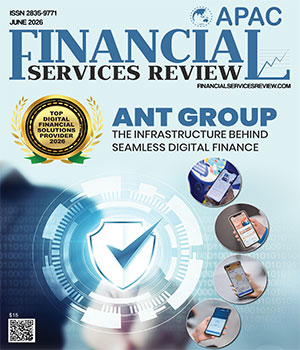
This issue features Ant Group, recognized as the Top Digital Financial Solutions Provider for 2026. Rather than positioning itself as a payments company, Ant Group has focused on building the infrastructure behind modern digital finance.
XChangeLab, awarded for the Top Interbank Service Provider in APAC 2026. Operating across more than 82 jurisdictions and supporting 25 currencies, XChangeLab has positioned itself as a key infrastructure partner for correspondent banking and cross-border settlement. Through its API-first platform and professional services approach, the company helps banks and fintech organizations access payment rails, correspondent accounts and realtime settlement capabilities with greater speed and operational efficiency.
Its work around CIPS integration, alternative clearing rails and programmable settlement infrastructure reflects a larger shift happening across global finance. Financial institutions are looking for systems that are not only faster and more scalable, but also more resilient in an environment where compliance requirements, geopolitical tensions and transaction complexity continue increasing.
Thomas Lagriffoul, Regional Director, Compliance APAC, Coface, examines how geopolitical fragmentation, regionalization and diverging regulatory frameworks are reshaping trade and financial risk management.
Meanwhile, Julia Chan, Regional Financial Planning and Analysis Director, Asia, Warner Music Group, discusses how P&L management is evolving into a more strategic leadership function. She emphasizes the importance of combining financial discipline with clear communication, actionable forecasting and data-driven decision-making to improve alignment and long-term business performance.
Together, the organizations and leaders featured in this issue reflect a broader reality shaping the financial sector today. Success increasingly depends on operational clarity, resilient infrastructure and the ability to simplify complexity into practical, measurable action.
